Reilly Shields, Sociology & English '20
A Literature Review of Punished by Rewards by Alfie Kohn and Summerhill School a New View of Childhood by A.S. Neill
I had always had an unresolved feeling that my education could be doing more for my sense of direction in life and I luckily stumbled onto my own sense of purpose with little help from my early educational experiences. My goal for this paper was to identify why I wasn’t able to find this sense of purpose sooner and if there were institutions that embodied principles of self-direction and effectively produced students that were encouraged to be autonomous learners from a young age.
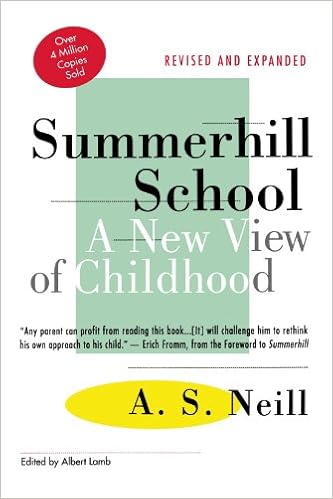

Today we face an epidemic in our educational system where children are losing their will to learn, thus producing a community of adults who find themselves disinterested in their careers and dissatisfied with day to day life. This disengagement from an early age in academics can be attributed to the ways in which we have structured our schools and curriculum. Controlling young learners can be argued to be the root cause of many of these issues and we can see from the courses that we are mandating children to take to the ways in which we assess, encourage, and reprimand their academic achievement that we are not preparing students to reach their full potential outside of the classroom. In this paper, I will use the findings of Alfie Kohn’s Punished by Rewards on our society’s “reliance on carrot-and-stick psychology… and rewards at home, at school, and at work” (Kohn) alongside A.S. Neill’s Summerhill School, a New View of Childhood, which details the experiment of creating a learning environment free of “all discipline, all direction, all suggestion, all moral training, (and) all religious instruction” (Neill 9), to explore how students are negatively impacted by our current methods of education and how we might improve them based on their conclusions.
In Punished By Rewards Kohn explains that Pop Behaviorism, which is the psychological theory that claims that reward-seeking and punishment avoiding impulses are the core drivers of human behavior, “has come to suffuse our lives” (Kohn 14). In all facets of America’s social spheres, Kohn says that we are being conditioned from a young age to move through life seeking to be rewarded or avoid being punished for our behavior, academic achievements, and work outcomes. This presents not only a moral dilemma when it comes to basic human dignity (this social system is compared to the ways in which we control pets or cattle in the book), but a developmental crisis for students who are having their academic intrinsic motivation stripped away.
Kohn describes how the conventional ideology that we subscribe to as Americans where doing a satisfactory job on an assignment or behaving well equals a payoff or reward in actuality creates a dependence on validation or a fear of failure in students. Those who can achieve success within the highly structured and punitive curriculum of schools often lose sight of why they are learning the material or become disengaged when they are given task contingent rewards (rewards are given for participating in an activity) seeking only to achieve a certain grade or accolade instead of deeply engaging with the material. This can be a dangerous path to lead young students down as Kohn claims, “rewards do not require any attention to reasons that the trouble developed in the first place” (Kohn 59) which means that students may not actually be learning to explore the topics covered, but they also will not be encouraged to explore subjects or disciplines that they find intrinsically interesting to them because it may not yield the grade or rewards they have been taught to chase.
On the other side of the coin, students who may struggle with certain topics or are behind on the developmental learning curve in comparison to their peers will disengage from school work when grades put them into competition with their fellow classmates leaving them with a diminished sense of competence in the classroom. Kohn does offer solutions, however, that could minimize psychological damage incurred on students by the current academic system and promote a healthy approach to learning that seeks to empower kids to pursue their innate academic interests. Kohn posits that diminishing the emphasis on the results of student’s academic endeavors, fostering an environment based on process-based goals and involvement, and encouraging students to make mistakes in the classroom will create a climate that fosters improved efficacy and self-directed learning for kids. Kohn also recommended that teachers try to avoid decontextualized curriculum and learning where the student cannot see the relevance of information they are being presented, instead suggesting that teachers bring their students into the decision making when it comes to curriculum. Finally, Kohn addresses the issue competition can create in the classroom setting, offering a simple solution to the toxic environment that it can breed between peers: more collaboration. Kohn explains that when students work collaboratively together an environment is created where kids can aid in each other’s understanding of the material and intellectual challenge one another in a way that supports the attainment of new knowledge.
On the other side of the coin, students who may struggle with certain topics or are behind on the developmental learning curve in comparison to their peers will disengage from school work when grades put them into competition with their fellow classmates leaving them with a diminished sense of competence in the classroom. Kohn does offer solutions, however, that could minimize psychological damage incurred on students by the current academic system and promote a healthy approach to learning that seeks to empower kids to pursue their innate academic interests. Kohn posits that diminishing the emphasis on the results of student’s academic endeavors, fostering an environment based on process-based goals and involvement, and encouraging students to make mistakes in the classroom will create a climate that fosters improved efficacy and self-directed learning for kids. Kohn also recommended that teachers try to avoid decontextualized curriculum and learning where the student cannot see the relevance of information they are being presented, instead suggesting that teachers bring their students into the decision making when it comes to curriculum. Finally, Kohn addresses the issue competition can create in the classroom setting, offering a simple solution to the toxic environment that it can breed between peers: more collaboration. Kohn explains that when students work collaboratively together an environment is created where kids can aid in each other’s understanding of the material and intellectual challenge one another in a way that supports the attainment of new knowledge.
While Kohn dissects smaller case studies to present the reader with evidence of the motivational shortcomings in our educational systems and their potential remedies, A.S. Neill and his documentation of the Summerhill School that he founded builds on many of Kohn’s theories of the positive impact self-regulation on children’s learning and shows us what this type of education could look like in the microcosm of a school that promotes absolute student freedom. Neill firmly believed that, “A child is innately wise and realistic. If left to himself without adult suggestion of any kind, he will develop as far as he is capable of developing” (Neill 9) Neil mirrors Kohn’s sentiments when it comes to the control of students, as he believed that children could not be forced or coerced into learning. For Neill this belief manifested itself in the Summerhill school where learning through play was prioritized, classes and courses of study were optional, teachers were seen as peers, not authoritarian figures, and disciplinary measures were self-governed by the students. Neil believed that all children deserve the right to play and that putting timetables on children’s development by deciding when this play stops could be extremely detrimental to the well being going as far as to claim that, “when a child has lost the ability to play, he is physically dead and a danger to any child that comes into contact with him” (Neil 39) Neil elaborated on this statement by saying that play keeps a child’s imagination alive, teaches them how to interact socially, and allows them to not only stay physically healthy but to explore the world in a way that will inform their intrinsic interests. Neil says that, “fear is at the root of adult antagonism to children’s play” (39) Parents everywhere are terrified that too much play and not enough structure will breed a lazy and unmotivated child; however, Neill found the opposite to be true in his experience at the Summerhill school. What many parents perceived as “laziness” was found by Neill to simply be a lack of interest or intrinsic motivation to do a particular type of work.
Neill found that kids who lived through play and were free to explore their imagination were better able to self direct their learning to meet their interests and consequently assess the work they wanted to go into later in life saying, “if your philosophy of life is a good one the job you end up doing is not of the highest importance” (Neill 41). In this way, Neill builds on Kohn’s suggestion of self-directed learning but takes a more radical and unstructured approach. Kohn suggests that the student should be brought in on curriculum decisions to inform teacher’s construction of the academics in order to encourage a sense of intrinsic motivation within the class. Neill takes student decisions on curriculum to the extreme end of the spectrum. He suggests that a child should have no regulation when it comes to academics giving the student complete autonomy over what they choose to study, whether or not they are tested, and how often they will attend class. Neil believed that children have an innate, “longing to be free, to escape molding by adults who do not know how to live themselves” (Neill 104) and that when a student is given this complete freedom to self-direct they develop extreme self-efficacy and confidence in themselves that cannot be shaken.
Neill found that kids who lived through play and were free to explore their imagination were better able to self direct their learning to meet their interests and consequently assess the work they wanted to go into later in life saying, “if your philosophy of life is a good one the job you end up doing is not of the highest importance” (Neill 41). In this way, Neill builds on Kohn’s suggestion of self-directed learning but takes a more radical and unstructured approach. Kohn suggests that the student should be brought in on curriculum decisions to inform teacher’s construction of the academics in order to encourage a sense of intrinsic motivation within the class. Neill takes student decisions on curriculum to the extreme end of the spectrum. He suggests that a child should have no regulation when it comes to academics giving the student complete autonomy over what they choose to study, whether or not they are tested, and how often they will attend class. Neil believed that children have an innate, “longing to be free, to escape molding by adults who do not know how to live themselves” (Neill 104) and that when a student is given this complete freedom to self-direct they develop extreme self-efficacy and confidence in themselves that cannot be shaken.
Another key principle that Neill preached in his book was the merit of self-government and instilling a sense of civic responsibility in students. At the Summerhill schools matter of discipline were handled in a forum style where a rotating student chairman lead the meetings each week. Every student, teacher, and staff member was allotted one vote of equal weight when it came to matters discussed. The arbitrary and total authoritarian power that most teachers and staff have over students in more traditional schools was criticized by Kohen’s finding that punishment for the sake of having complicit and docile students simply encourages these kids to not get caught the next time they choose to act up. Neill found that Summerhill’s unique method of discipline removed this ineffective god complex teachers have with their students and replaced it with a more equitable system of peer judgment that also had positive educational outcomes. Neil came to two important conclusions when it came to this method that, “no child will go on for years being disliked and criticized” (Neill 27) by their peers and will often develop a more devoted sense of accountability. Also, having to voice your opinion on these group matters or having to defend the practicality of your argument to your peers promotes a necessary eloquence in public speaking.
When students are not given autonomy or freedoms in the developmental stages of education they are left to either chase societal barometers of success that often ignore/never allow them to realize their own intrinsic academic interests, or to develop feelings of inadequacy and risk aversion when it comes to their learning. We are developing students who no longer want to learn, but rather simply want to survive their time in school. By examining the works of Alfie Kohn and A.S. Neil I feel as though I have found the theoretical framework in Kohn that can begin to explain why our current education system is failing so many students and how we can start to help, while also being able to find an extreme, yet, salient example in Neill of how these theories could be implemented in a high functioning academic structure. My culminating research question will take into account the more practical and realistic viewpoint of Kohn on the difficulties of reforming a deeply embedded education system in America to determine whether it is a realistic possibility to emulate a Summerhill type program.
For my own further research on the topic that will build off the findings of Kohn and Neill I will ask:
What is the best way (if there are already examples) to establish a school that gives students more complete autonomy in their learning in an American education system that values the cyclical power structure of control and standardized testing?
I chose this question because it is obvious to me from my own lived experience in the Chicago Public School system, a private Catholic high school, and esteemed liberal arts college that at all levels of education in America there is a desperate need to help students find academic paths that will do more than just get them a job and allow them to self-sustain post-academia. Student’s across the country are stuck in a cyclical system that churns out productive workers, but ignores these people’s need for true self-direction and a feeling of purpose in their studies. I had always had an unresolved feeling that my education could be doing more for my sense of direction in life and while I may have luckily stumbled onto my own sense of purpose with little help from my educational experiences my goal for this paper was to identify why I wasn’t able to find this sense of purpose earlier and if there were institutions that embodied and effectively produced students that were encouraged to do this from a young age. By juxtaposing these two texts I feel as though I’ve finally found the first stepping stones to answering these questions. I’m aware that Neill’s Summerhill school was founded in 1921 and his account of the school is extremely dated, which leaves this utopian ideal of education possibly too far removed from our current society to be an effective model for my research. I’m still left with questions as to the actual success of the students who attended Summerhill and will continue to look further into the accounts of students who attended this academy.
Supplementary Reading Links

/4136760-article-what-is-maslows-hierarchy-of-needs-5a97179aeb97de003668392e.png)


No comments:
Post a Comment